
Translation of blurb and description from the Brazilian edition, not used in the English version:
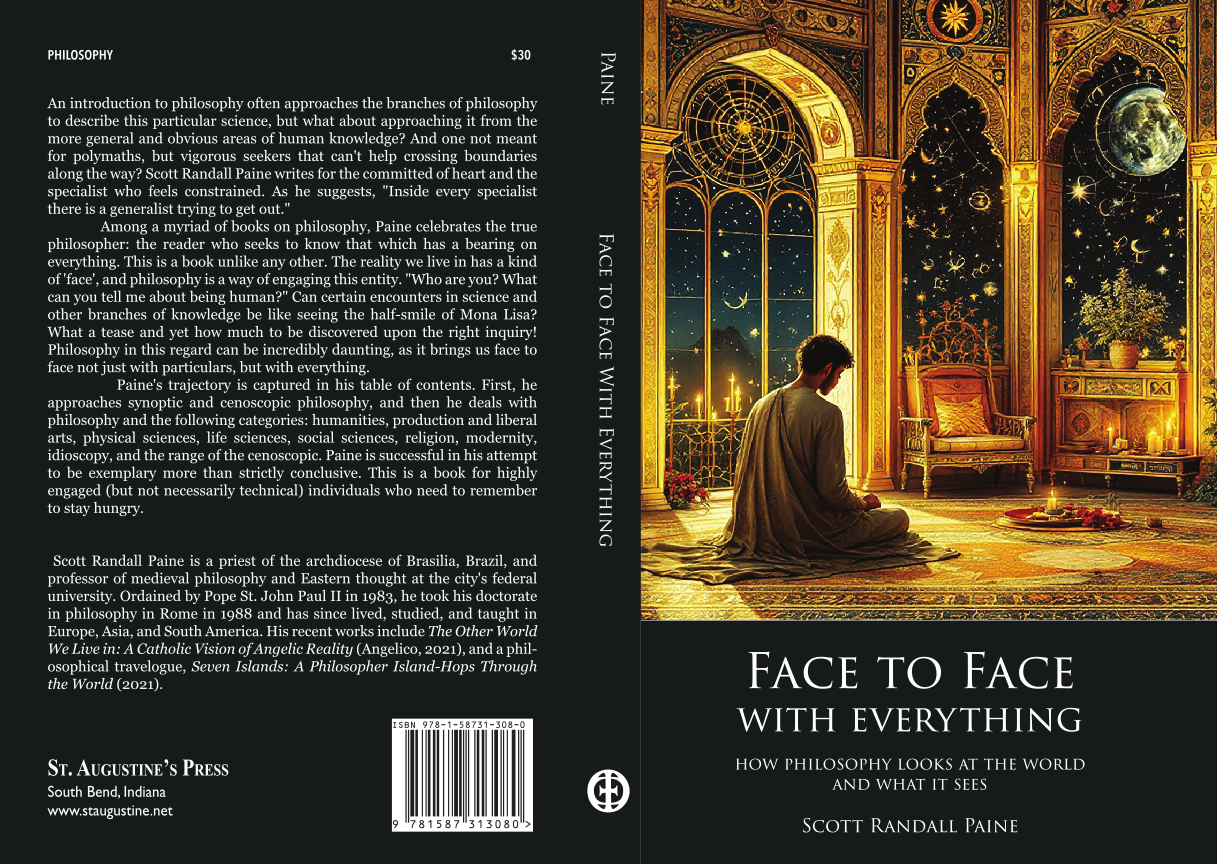
Modern science has disclosed so many new perspectives on reality we easily lose sight of the most revealing perspective of all: the human. Worse yet, one or the other of the new optics—the astrophysical or the evolutionary, for instance—not infrequently ends up claiming final authority in defining our nature and position in the world. Our unique human body, however, with its sovereign countenance (without technical accessories), together with our mind and its native powers (minus hypotheses or premature calculations), already possesses the most embracing and trustworthy viewpoint of them all. The present book mounts a defence of this original human perspective, but with a twist.
Plato identified the “synoptic” (reality seen in its most embracing context and most intimate connections) as the coveted goal of philosophical knowledge. Today, however, intimidated by the hegemonic sciences, we can only preserve such a holistic view (objectively speaking) if we simultaneously cultivate a corresponding and proportional point of view (subjectively speaking). This last has been given the name of the “cenoscopic” (a “common” view). Other more focalized approaches (“idioscopic,” with a specialized look) easily bewilder us if they lack the contextualization and interpretation that only an unmistakably human perspective can afford.
In this book, cenoscopy will be identified and described as the only outlook capable of rescuing philosophy not only as independent of the new sciences, but also as positioned in such a way as to find meaning, purpose and value within their discoveries, and even more importantly, beyond them.
* * *
The human face is a paradoxical phenomenon—by definition, a surface, but clearly the most profound surface that exists. There is a multifaceted relation between its immediate appearance and the ideas, intentions and loves that lie not behind it, but within. This is where the human mystery resides in all its beauty, drama and challenge. Together with the two hands, the face is the maestro of the symphony of the five senses that compose the network of contacts that present the human person to the world. However, vis-à-vis our face we encounter not only the faces of our fellows (and of the animals), but also the face of the universe. This face too possesses its superficial profundities.
Nonetheless, the great successes of modern science and technology have convinced us that the reality of the world lies not in those appearances, but rather in the forces and occult dimensions it both discloses and exploits. This claim, which normally goes unchallenged, will be disputed in the pages of this book. We lose so much when we doubt the evident appearances of the Earth over which we walk, and the meaning of the Sun, the Moon and the celestial firmament that shine overhead. The poets and musicians already know this. And their knowledge is far more than simple diversion or a mere font of relaxation after more “serious” labors. It is a knowledge both real and profound.
Philosophy, however, has largely refused to follow the guiding stars of the poets and often enough has surrendered to contemporary scientism. This book will see such surrender as a treason against both our senses and our common sense. The loss is incalculable when we reduce, for instance, the reality of the Sun—which gives us warmth, light and life—to a mere ball of thermodynamic processes, overlooking its majesty and powerful suggestion of transcendence. And the stars, as they shine before our naked eyes, really do exist in the human world exactly as they appear. This terrestrial perspective, with all its human proportionality, is no delusion, no anthropomorphism, no false geocentrism, but rather the key to the only insights that are of interest to the humanities, philosophy and religion. These intuitions alone possess the range and order that can meaningfully situate the otherwise orphaned details we learn from the specialized sciences.
The restoration of this perspective, both “synoptic” and “cenoscopic,” is the project of this book. But this is done not through the recitation of poems, the study of a philosophical curriculum or an adventure of religious faith (all highly recommended!), but instead by means of an intellectual journey through more familiar regions of knowledge and art. It will offer indeed an exercise in philosophy, but not a course. As always, philosophers invite us not to know everything about something, but rather something about everything. We will be made to stand face to face with the total mystery of the reality that both surrounds and inhabits us, the presence of which is unavoidable, even if permanently, and happily, beyond our comprehension.
_____________________________
reviews:
The Best Books of 2025 According to Unamuno Magazine
The best books published in 2025 according to the contributors of Unamuno Magazine. (unamuno.com.br)
Face to Face with Everything: How Philosophy Looks at the World and What It Sees – Scott Randall Paine (Phi Publisher)
by João Paulo Cirilo
Brazil had the privilege of being the first country to see the launch, in its publishing market, of the last book written by the American philosopher, Catholic priest, and university professor—but almost 100% Brazilian—Scott Randall Paine. And, fortunately for us, it is a book, in its theme and approach, practically sui generis in our “market of ideas”: it is an introduction not to Philosophy, not to the History of Philosophy; it is an introduction, for lack of a better term, to the power of Philosophy, to the possibilities of this Mother Science so mistreated throughout our history. It is also, I dare say, a response to the audacity and arrogance of modern sciences, so full of themselves in the last hundred years, but which fail, despite undeniable efforts and progress, to give us satisfactory answers to what we see and experience every day, as if what mattered, in the end, were only the physical definitions of quarks, the latest astrophysical discovery of the moment, or the public debate between Darwinists and neo-Darwinists. All these things are important, stimulating at the very least, but they are not enough—before we understand these things, we need to see them.
And who would help us in this looking, in this seeing of things as they are? Philosophy, argues the author. This seems to be the correct answer: it is Philosophy that truly helps us to train this seeing, this common gaze so constitutive of our existence—the common gaze, here contrasted with the technical and specific gaze, is in fact the subject of the book. In clear language, Scott Randall Paine shows us this axial function of Philosophy, where all spheres of human life — from the most everyday to the most specialized and scientific — placed in an infinite relational network, can use it, Philosophy, as a contact surface, as an axis for these relationships: Philosophy and Chemistry, Philosophy and Art, Philosophy and Physics, Philosophy and Sociology… The book addresses, throughout its few but profound chapters, precisely these relationships, always starting from the pole of “Philosophy” to the other area of knowledge.
All this is articulated from ideas and authors who are admittedly outside the academic radar — I name only two who, if all goes well in the coming decades, will gain space among Brazilians: the unclassifiable Eugen Rosenstock-Huessy (luckily an author who has been published in recent years in these parts) and John Deely, the obscure Thomist-semiotician even for English-speaking readers.
I won’t say more so as not to deprive you, the reader, of the complete experience I myself had—rediscovering, page after page, the true purpose of a life dedicated to Truth: to be able to see everything, one day, face to face, without any fear.