

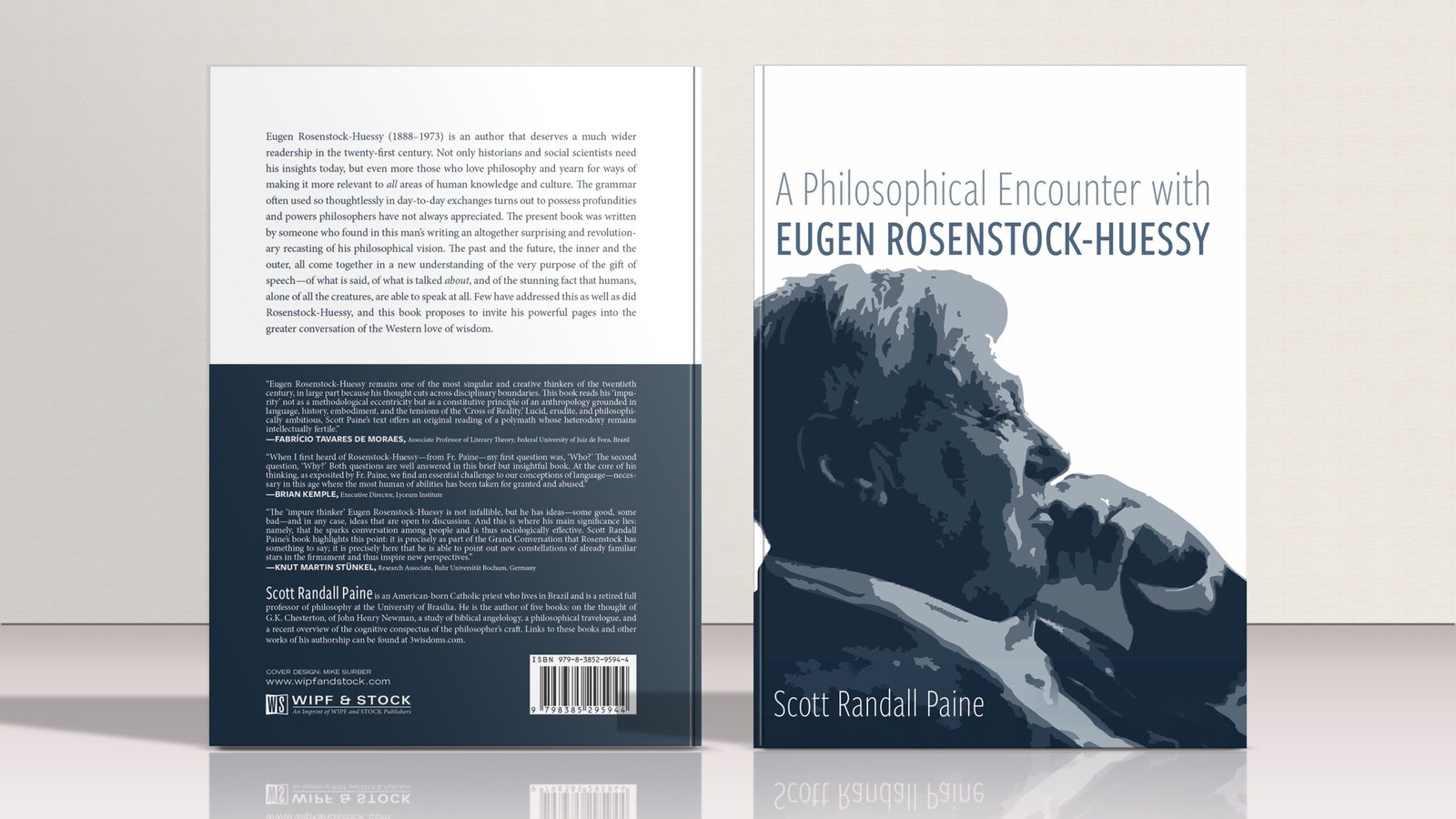
A Philosophical Encounter with Eugen Rosenstock-Huessy

Praise for this book
Eugen Rosenstock-Huessy remains one of the most singular and creative thinkers of the twentieth century, in large part because his thought cuts across disciplinary boundaries. This book reads his ‘impurity’ not as a methodological eccentricity but as a constitutive principle of an anthropology grounded in language, history, embodiment, and the tensions of the ‘Cross of Reality.’ Lucid, erudite, and philosophically ambitious, Scott Paine’s text offers an original reading of a polymath whose heterodoxy remains intellectually fertile.
Fabrício Tavares de Moraes, Associate Professor of Literary Theory, Federal University of Juiz de Fora, Brazil
When I first heard of Rosenstock-Huessy–from Fr. Paine–my first question was, ‘Who?’ The second question, ‘Why?’ Both questions are well answered in this brief but insightful book. At the core of his thinking, as exposited by Fr. Paine, we find an essential challenge to our conceptions of language–necessary in this age where the most human of abilities has been taken for granted and abused.
Brian Kemple, Executive Director, Lyceum Institute
The ‘impure thinker’ Eugen Rosenstock-Huessy is not infallible, but he has ideas–some good, some bad–and in any case, ideas that are open to discussion. And this is where his main significance lies: namely, that he sparks conversation among people and is thus sociologically effective. Scott Randall Paine’s book highlights this point: it is precisely as part of the Grand Conversation that Rosenstock has something to say; it is precisely here that he is able to point out new constellations of already familiar stars in the firmament and thus inspire new perspectives.
Knut Martin Stünkel, Research Associate, Ruhr Universität Bochum, Germany